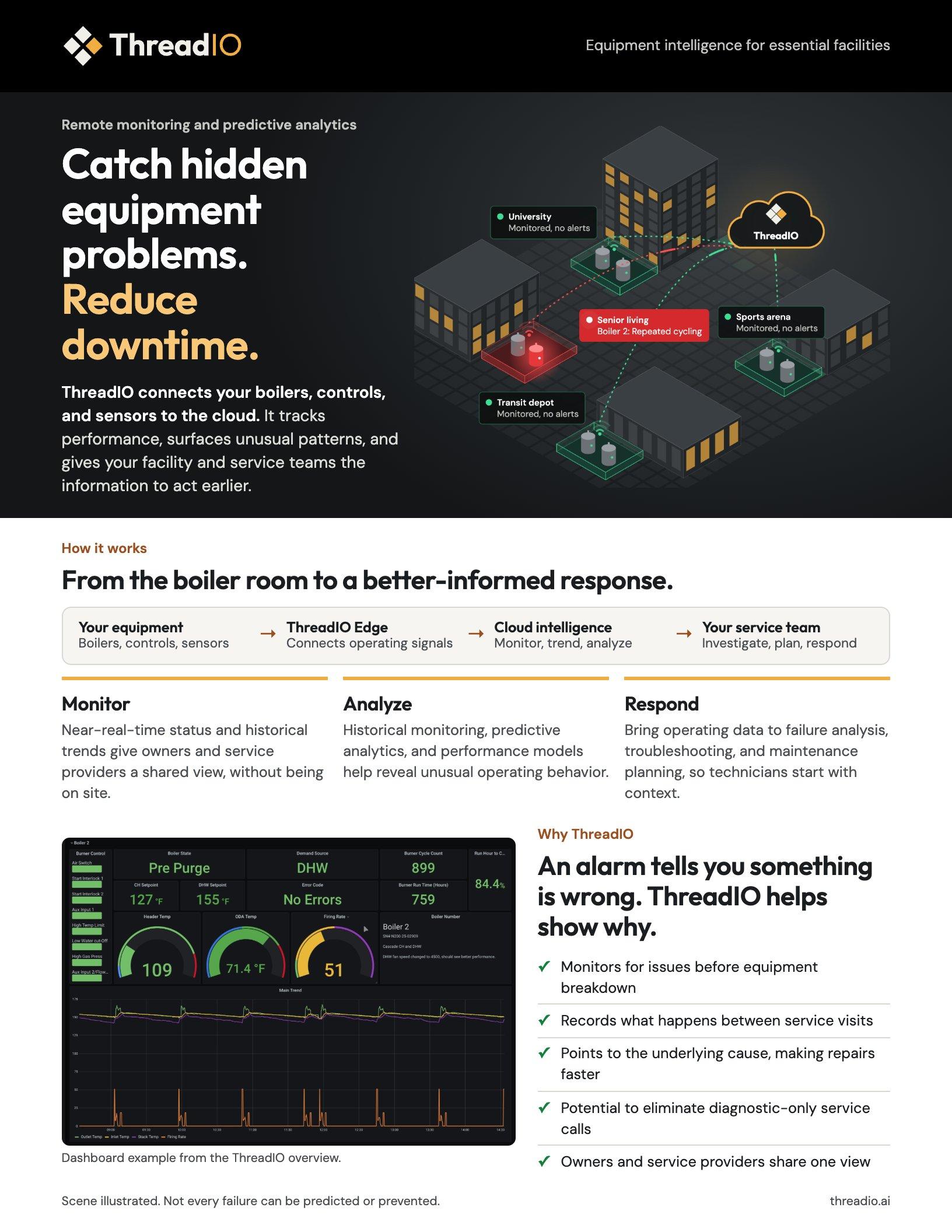
ThreadIO connects your boilers, controls, and sensors to the cloud. It tracks performance, surfaces unusual patterns, and gives your facility and service teams the information to act earlier.
Less unplanned downtimeFewer diagnostic-only visitsLess hidden energy waste
UniversityMonitored, no alerts
Sports arenaMonitored, no alerts
Senior livingBoiler 2: Repeated cycling
Transit depotMonitored, no alerts
ThreadIO
Needs attention: boiler 2, repeated cycling
Healthy: monitored, no alerts
01Your equipmentBoilers · controls · sensors
→
02ThreadIO EdgeConnect operating signals
→
03Cloud intelligenceMonitor · trend · analyze
→
04Your service teamInvestigate · plan · respond
Built for the teams responsible for critical facilities
Universities
Schools
Major sporting arenas
Entertainment venues
Senior living
Transit facilities
Essential facilities
Universities
Schools
Major sporting arenas
Entertainment venues
Senior living
Transit facilities
Essential facilities
Why ThreadIO
Downtime is expensive. Finding the cause shouldn’t be.
A building-management alarm can tell you something is wrong. Understanding the cause still takes operating history, equipment knowledge, and a service team with the right context. ThreadIO connects those pieces, so problems are easier to investigate before they become expensive interruptions.
How ThreadIO compares
Standard alarm
Single service visit
ThreadIO
Catches issues before a breakdown
Triggers once a limit is crossed
Only if it shows during the visit
The ThreadIO advantageProactively monitors issues before equipment breakdown happens
Tells you something is wrong
At that moment
While on site
With the operating history behind it
Shows what happened over time
One moment
One moment
Records what happens between visits
Points to the underlying cause
Flags the condition only
What the technician can see that day
Patterns point to the cause, making repairs faster
Gives the technician context first
The alarm condition only
Diagnosis starts on site
Technician arrives with context
Finds waste hiding in normal operation
Stays quiet within limits
Only if noticed on site
Surfaces excess cycling and unnecessary heating
Gives everyone the same picture
Stays in the building system
Visit notes afterward
Owners and service providers share one view
Not every failure can be predicted or prevented. A qualified service professional evaluates the cause and performs the work.
How much does equipment downtime cost?
Consider hot-water continuity, resident comfort, staff overtime, and temporary heating or hot-water equipment.
Estimated annual downtime cost$29,000$14,500 per outage
Starting values are illustrative; enter your own costs. (Hours × hourly impact + emergency response) × outages per year. Estimates exposure, not guaranteed ThreadIO savings. Hardware, installation, and field service are quoted separately.
How it works
From the boiler room to a better-informed response.
One connected loop: collect the signals, understand performance over time, and put the findings in the hands of the people who maintain your equipment.
Equipment
Edge
Cloud
See critical equipment without being on site.
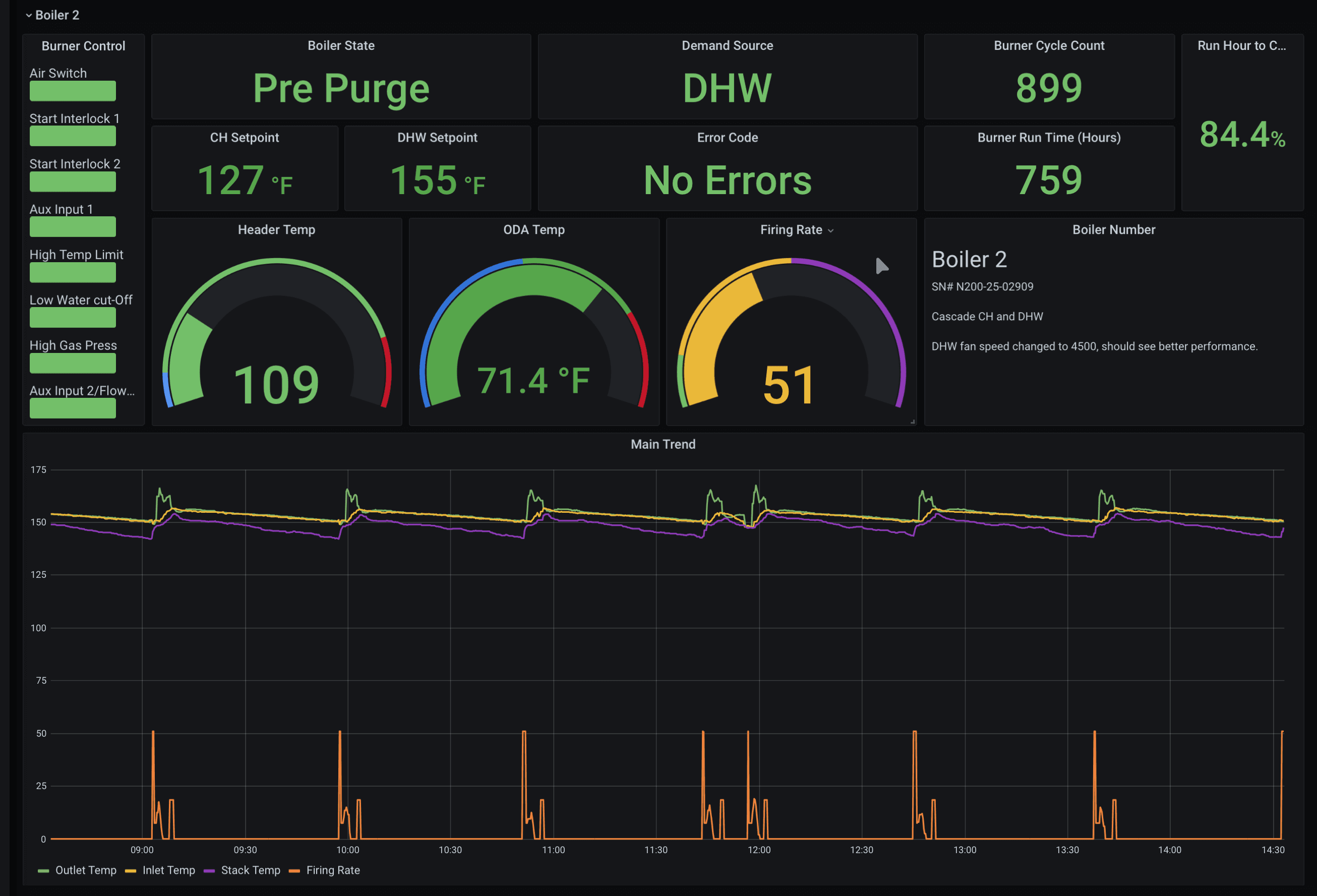
ThreadIO Edge securely connects plant data to the cloud. Near-real-time status and historical trends give owners and service providers a shared view of how equipment is operating.
Easy-to-use dashboard
Boiler and control status
Temperature, operating cycles, and run time
Add-on sensors for additional system visibility
Why it mattersYour team can review equipment performance remotely instead of starting every investigation on site.
ThreadIO equipment intelligenceOverview example
Dashboard image from the ThreadIO overview · Not a live connection
History
Patterns
Insight
Find the changes that deserve attention.
Historical monitoring, predictive analytics, and performance models help reveal unusual operating behavior. Connect today’s condition to the pattern that came before it.
Review equipment performance over time
Investigate abnormal cycling and sensor trends
Use operating history to improve performance models
Why it mattersHidden operating problems become a focused investigation, with evidence that a single alarm cannot provide.
ThreadIO equipment intelligenceOverview example
Sustained reading above threshold
Boiler cycles per call
3–4
Hot-water run length
2–3 days
Header temp vs. setpoint
150°F / 100°F
ThreadIO analysisConnect operating history to the problem, then investigate pressure, piping, and heat transfer.
Dashboard images from the ThreadIO overview, with findings from Shaker Place · Not a live connection
Insight
Service team
Action
Help the right people act on what matters.
Bring operating data to owners and service providers for failure analysis, troubleshooting, and maintenance planning. Support service response to equipment faults, emissions anomalies, and preventive-maintenance needs.
Share history and investigation context
Plan service around equipment condition
Connect response planning with parts visibility
Why it mattersTechnicians can start with context, helping reduce diagnostic-only trips and focus the work on the underlying issue.
ThreadIO equipment intelligenceSample report
Service reportAction recommended
Site
Shaker Place, Albany, NY
Equipment
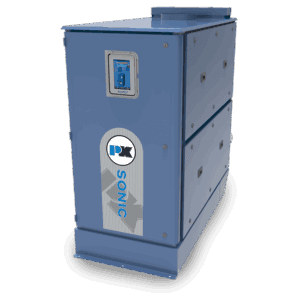
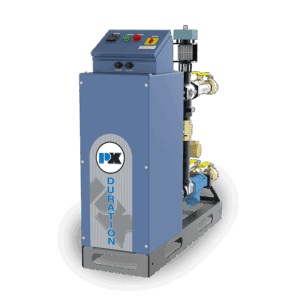
Six Sonic 4000 boilers, two Duration exchangers
Issue
Overheating and repeated cycling
Investigation readings
Finding
Reading
Context
Hot-water run length
2–3 days
Observed in July
Boiler cycles per hot-water call
3–4
Repeated cycling
Water entering building header
150°F
100°F setpoint
System pressure
50 psi
30 psi valve rating
Skid-to-boiler water flow
Reduced 50%
Parallel piping
Corrective opportunities for your service team
Reduce system pressure to the 30 psi valve rating
Correct the parallel hot-water piping
Address missing expansion control on the hot-water side
Example service report based on the Shaker Place findings
↻
The loop keeps improving. Operating history informs performance models, and the findings support future maintenance decisions.
What your organization gains
More time to act. Less time reacting.
Continuity
Reduce the risk of unplanned downtime.
Find abnormal behavior earlier and make maintenance decisions with a clearer view of equipment condition.
Service efficiency
Make the first service visit more informed.
Share operating history before a technician arrives, with the potential to avoid diagnostic-only calls.
Team capacity
Extend the reach of experienced staff.
Give facilities and service providers remote visibility into critical equipment, rather than relying on constant on-site observation.
Operating cost
Find waste that hides in normal operation.
Investigate excessive cycling, unnecessary heating, and equipment working against the rest of the system.
The value in practice: Shaker Place, Albany
Three hidden problems. Patterns a service visit can miss.
A service visit captures a moment. ThreadIO connects operating history over time, revealing patterns that can be difficult to spot during individual visits. At Shaker Place, monitoring helped uncover repeated cycling, excess heat, and a pressure mismatch across the boiler and hot-water system.
What was found3–4boiler cycles per hot-water call
Domestic-hot-water runs lasted 2–3 days in July, with repeated boiler cycling.
Why it mattered
The system needed more than another reset.
Investigation identified parallel piping between the DHW skid and boilers, reported to reduce water flow by 50%.
The corrective opportunity
Address the cause of the cycling.
Correct the piping arrangement to reduce cycles, component wear, and fuel waste.
What was found150°Fwater entering a header set to 100°F in July
Heating pumps ran during domestic-hot-water calls, sending unnecessary heat into the building header.
Why it mattered
Heating and cooling were working against each other.
The investigation described overheating spaces and chillers running to compensate. Missing DHW expansion control also allowed excess pressure and heat into the building loop.
The corrective opportunity
Keep heat where it is needed.
Address unwanted heat transfer and expansion control to reduce overheating and the associated fuel and electrical waste.
What was found50 psisystem pressure vs. a 30 psi valve rating
Investigation found system pressure above the stated maximum rating of the building’s reheat valves.
Why it mattered
Repeated valve replacement did not address the pressure.
The overview links valve bypass to overheating and notes that valves were being changed repeatedly, adding parts and labor costs.
The corrective opportunity
Correct the pressure mismatch.
The overview identified reducing pressure to the valve rating as a corrective opportunity. Site personnel must evaluate and implement any setting changes.
Findings and corrective opportunities from the supplied proof-of-concept overview. Actual savings depend on implementation and operating conditions; no verified dollar result was supplied.
Equipment ThreadIO monitors
Built for what is in your plant room.
Boilers, hot-water systems, heat exchangers, control valves, and more, along with their controls and sensors.
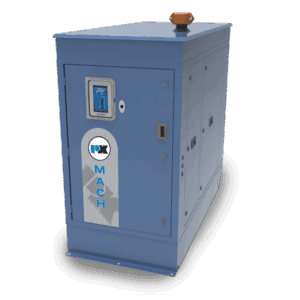
Commercial boilers
State, temperatures, operating cycles, and run hours.
Domestic hot-water systems
Long hot-water runs, repeated cycling, and unwanted heat transfer.
Condensing boilers
Firing rate, setpoints, demand source, and error codes.
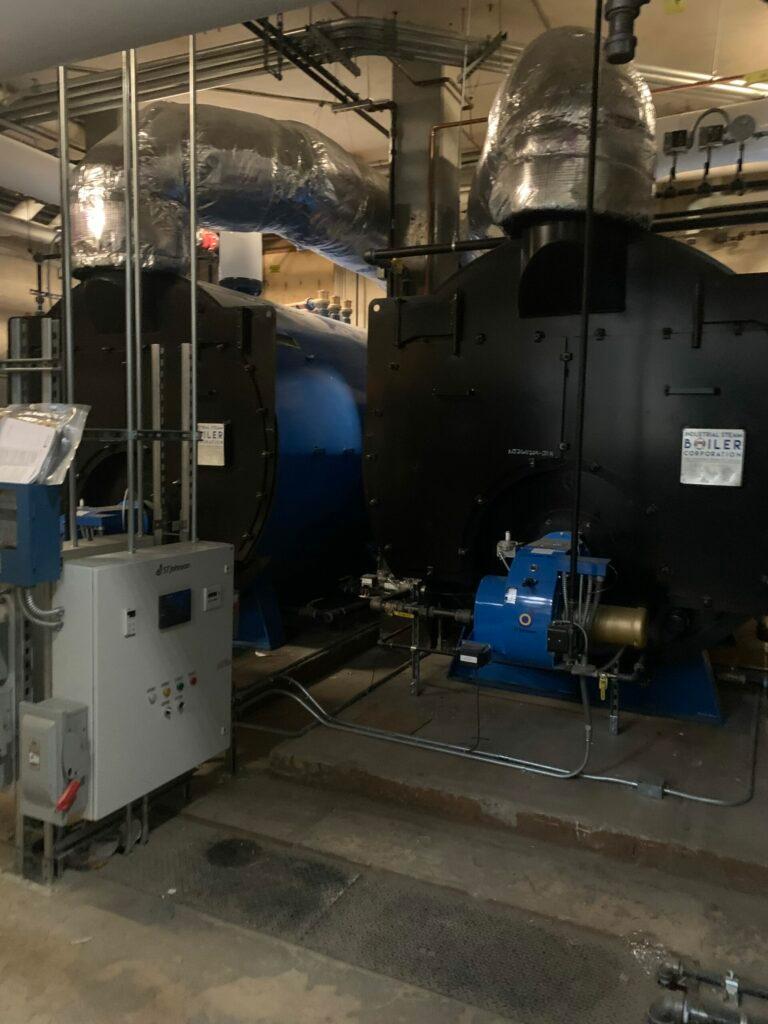
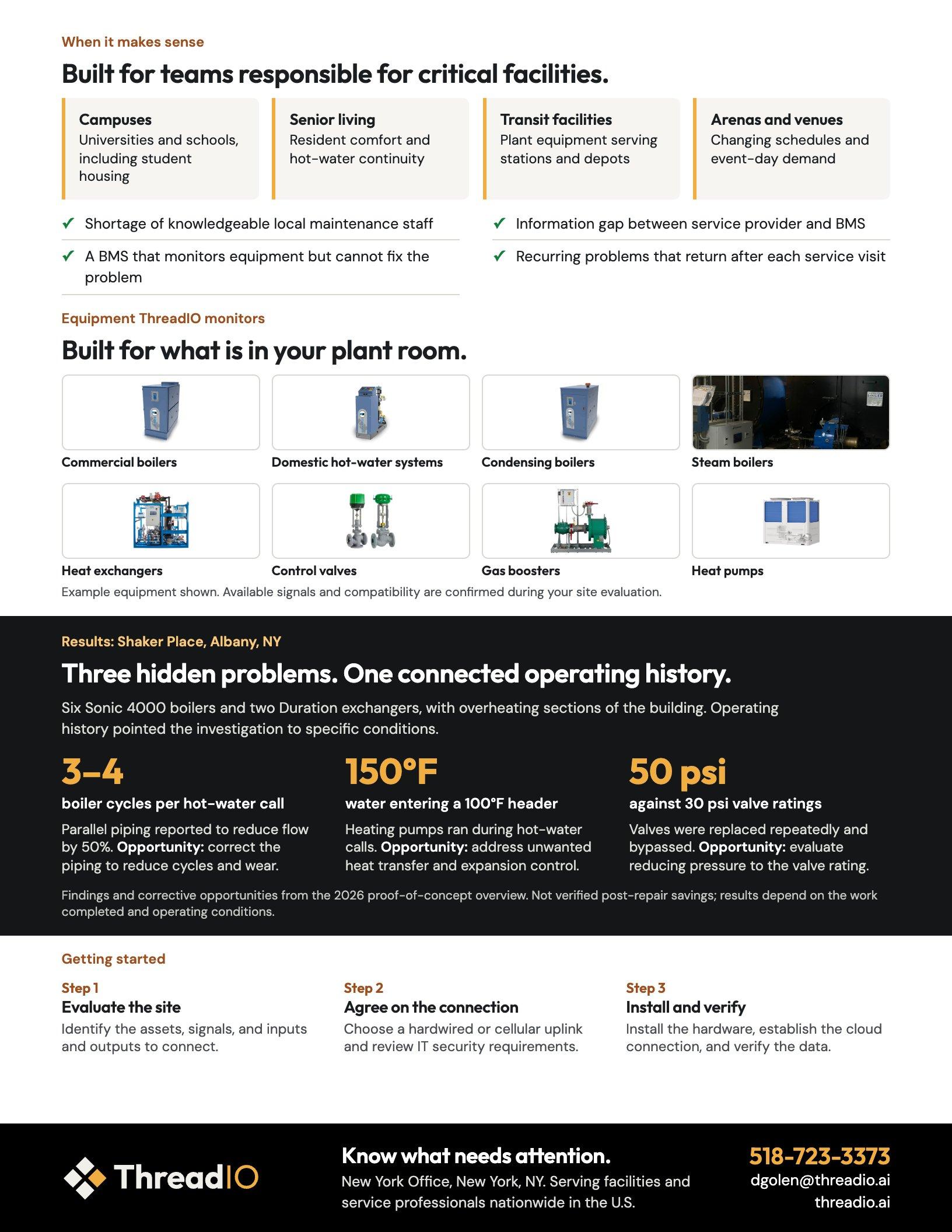
A two-page summary of what ThreadIO is, how it works, the equipment it monitors, and the Shaker Place findings, with contact details for the next step.
ThreadIO is a remote equipment monitoring and predictive analytics service for facilities teams and service professionals. It connects boilers, controls, and sensors to the cloud, tracks performance, and surfaces unusual patterns so teams can act earlier.
What equipment can ThreadIO monitor?
ThreadIO monitors plant equipment including commercial, condensing, and steam boilers, domestic hot-water systems, heat exchangers, control valves, gas boosters, and heat pumps, along with their controls and sensors. The site evaluation confirms available inputs, compatibility, and any additional sensors required.
When does remote equipment monitoring make sense?
It fits organizations short on knowledgeable local maintenance staff, teams whose building management system monitors boilers but does not fix the problem, and sites where the service provider cannot see what the building management system sees. Remote monitoring provides performance data to help minimize downtime, maximize performance, and identify hidden issues.
How is this different from a building-management alarm?
An alarm identifies a condition at a point in time. ThreadIO brings remote visibility, historical trends, and analysis into the investigation and service workflow. Existing controls and building-management requirements are reviewed during scoping.
Can it help when repeated service visits have not resolved an issue?
Operating history may reveal behavior that does not occur during a visit. ThreadIO helps teams investigate recurring patterns and relationships between signals. A qualified service professional still needs to evaluate the cause and perform the appropriate work.
Does ThreadIO automatically repair equipment?
No. ThreadIO provides monitoring, insights, and service context. Inspection, repair, and response responsibilities are agreed with your facilities and service teams. Not every failure can be predicted or prevented.
How is monitoring priced?
Monthly software licensing is based on monitored device count and tier. Hardware, installation, commissioning, integrations, and field service are scoped separately. View pricing and estimate your license.
Where does ThreadIO operate?
ThreadIO operates from its New York Office in New York, NY, and serves facilities and service professionals nationwide in the U.S.
Make your equipment data useful.
Know what needs attention. Give your team a head start.
Tell us about your equipment and the operating problems you want to understand.