Three hidden problems. One connected operating history.
Monitoring at Shaker Place revealed patterns behind repeated boiler cycling and excess heat, giving the investigation a more focused starting point.
Technical contact: Dave Golen, Director of Automation & Controls ThreadIO · New York Office · 2026
The system
Six boilers. Two hot-water exchangers.
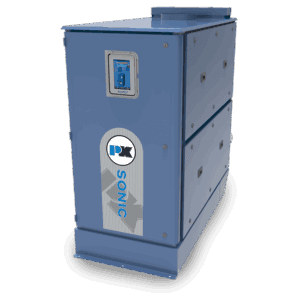
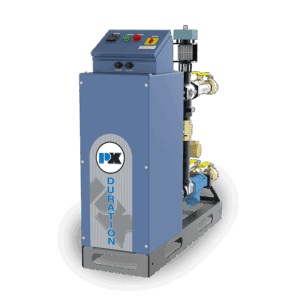
The project overview describes six Sonic 4000 boilers and two Duration domestic-hot-water exchangers at Shaker Place in Albany. Monitoring brought operating history into an investigation of overheating and inefficient system behavior.
This case study reports observations and corrective opportunities from the ThreadIO Cloud Overview. Completed repairs, post-repair measurements, and verified dollar savings are not documented here.
Sonic boiler. Six Sonic 4000 boilers at Shaker Place. Product photo, not the site.
Duration hot-water exchanger. Two at Shaker Place. Product photo, not the site.
What the operating data revealed.
Repeated cycling
Three to four cycles per hot-water call.
Domestic-hot-water runs lasted two to three days in July, with repeated boiler cycling. Investigation identified parallel piping between the hot-water skid and boilers, reported in the overview to reduce water flow by 50%.
Corrective opportunity: review and correct the piping arrangement to reduce unnecessary cycling and component wear.
Excess heat
Heat entered a system that did not need it.
Central-heating pumps operated during domestic-hot-water demand, introducing approximately 150°F water into a header set to 100°F. The resulting overheating prompted investigation of how the systems interacted.
Corrective opportunity: address unwanted heat transfer and review control and hydraulic conditions contributing to excess heating.
Pressure mismatch
Operating conditions exceeded valve ratings.
The overview reports approximately 50 psi system pressure against 30 psi valve ratings, allowing bypass and contributing to excess heat. Chillers were then compensating for that heat.
Corrective opportunity: evaluate and correct system pressure and related hydraulic conditions with the responsible service professionals.
The value: a more focused investigation.
An individual service visit captures conditions at one moment. Operating history can expose patterns that develop across hot-water calls, heating cycles, and changing demand. At Shaker Place, the findings connected repeated symptoms to specific conditions that warranted investigation.
Potential benefits included less unnecessary heating, reduced cycling, and lower fuel, electricity, and parts wear. These are corrective opportunities—not verified post-repair savings. Results depend on the work completed and subsequent operating conditions.
Source: ThreadIO Cloud Overview, Shaker Place proof-of-concept findings. Project year: 2026, supplied by ThreadIO. Technical contact: Dave Golen, Director of Automation & Controls. The facility is named with permission supplied by ThreadIO.
Any simulator amounts are illustrative and are not results from this project.